nf-core/circrna

















Introduction
nf-core/circrna is a bioinformatics pipeline to analyse total RNA sequencing data obtained from organisms with a reference genome and annotation. It takes a samplesheet and FASTQ files as input, performs quality control (QC), trimming, back-splice junction (BSJ) detection, annotation, quantification and miRNA target prediction of circular RNAs.
The pipeline is still under development, but the BSJ detection and quantification steps are already implemented and functional. The following features are planned to be implemented soon:
- Isoform-level circRNA detection and quantification
- circRNA-miRNA interaction analysis using SPONGE and spongEffects
- Improved downstream analyses
If you want to contribute, feel free to create an issue or pull request on the GitHub repository or join the Slack channel.
Pipeline summary
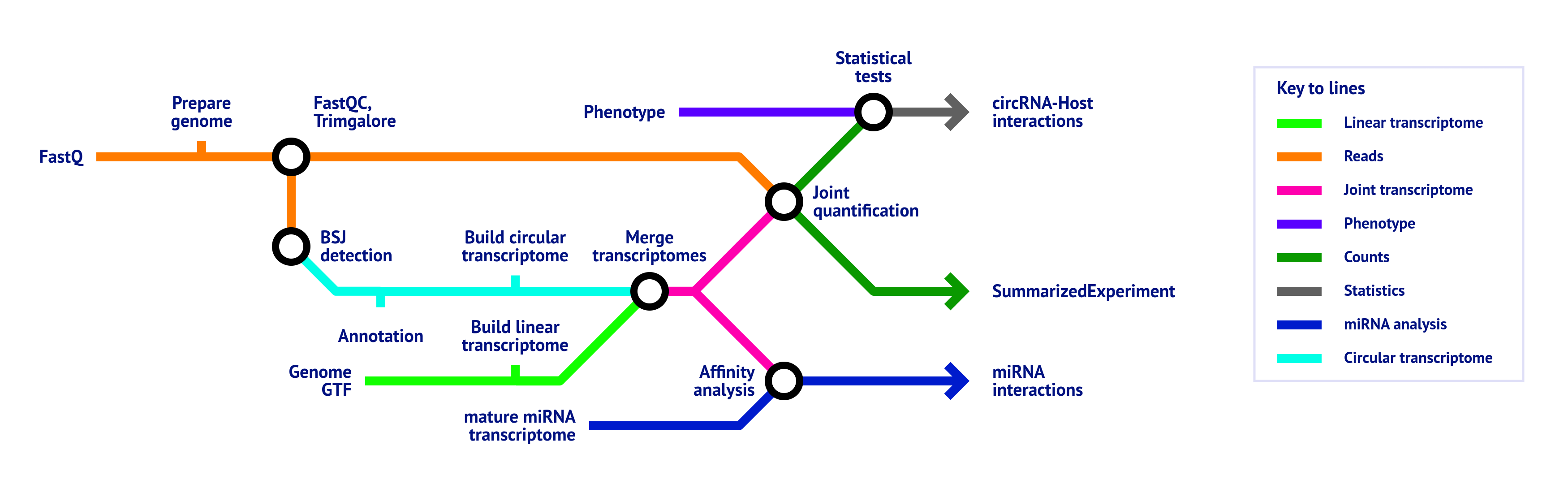
- Raw read QC (
FastQC) - Adapter trimming (
Trim Galore!) - BSJ detection
- circRNA annotation
- Based on a GTF file
- Based on database files (if provided)
- Extract circRNA sequences and build circular transcriptome
- Merge circular transcriptome with linear transcriptome derived from provided GTF
- Quantification of combined circular and linear transcriptome
- miRNA binding affinity analysis (only if the
matureparameter is provided)- Normalizes miRNA expression (only if the
mirna_expressionparameter is provided) - Binding site prediction
- Perform majority vote on binding sites
- Compute correlations between miRNA and transcript expression levels (only if the
mirna_expressionparameter is provided)
- Normalizes miRNA expression (only if the
- Statistical tests (only if the
phenotypeparameter is provided) - MultiQC report
MultiQC
Usage
Note
If you are new to Nextflow and nf-core, please refer to this page on how to set-up Nextflow. Make sure to test your setup with -profile test before running the workflow on actual data.
nf-core/circrna: a portable workflow for the quantification, miRNA target prediction and differential expression analysis of circular RNAs.
Barry Digby, Stephen P. Finn, & Pilib Ó Broin
BMC Bioinformatics 24, 27 (2023) doi: 10.1186/s12859-022-05125-8
An extensive list of references for the tools used by the pipeline can be found in the CITATIONS.md file.
You can cite the nf-core publication as follows:
The nf-core framework for community-curated bioinformatics pipelines.
Philip Ewels, Alexander Peltzer, Sven Fillinger, Harshil Patel, Johannes Alneberg, Andreas Wilm, Maxime Ulysse Garcia, Paolo Di Tommaso & Sven Nahnsen.
Nat Biotechnol. 2020 Feb 13. doi: 10.1038/s41587-020-0439-x.
miRNA options#
Define paths and threasholds for miRNA analysis.
Comma separated list of miRNA bindingsite prediction tools to use. Supported tools: miranda, targetscan.
More detail
Select one or a combination of miRNA bindingsite prediction tools for the pipeline e.g: --mirna_tools 'miranda,targetscan'
Minimum number of reads, a miRNA is required to have to pass filtering.
More detail
This parameter determines the minimum number of reads that a miRNA must have to pass filtering. The default is 5, meaning a miRNA must have at least 5 reads across the samples to be considered for analysis.
Specify the number of votes required for a miRNA to be further considered in downstream analysis.'
More detail
Controls the number of votes required for a binding site prediction to be considered valid. If a miRNA binding site was predicted by two different tools (e.g., miRanda and TargetScan), it receives two votes. By specifying additional tools for miRNA binding site prediction (using the 'mirna_min_tools' parameter), you can adjust the number of votes required for a binding site to be considered valid.