nf-core/fastqrepair
















Introduction
nf-core/fastqrepair is a bioinformatics pipeline that can be used to recover corrupted FASTQ.gz files, drop or fix uncompliant reads, remove unpaired reads, and settles reads that became disordered. It takes a samplesheet with FASTQ/FASTQ.gz files as input (both single-end and paired-end) and produces clean FASTQ files and QC reports.
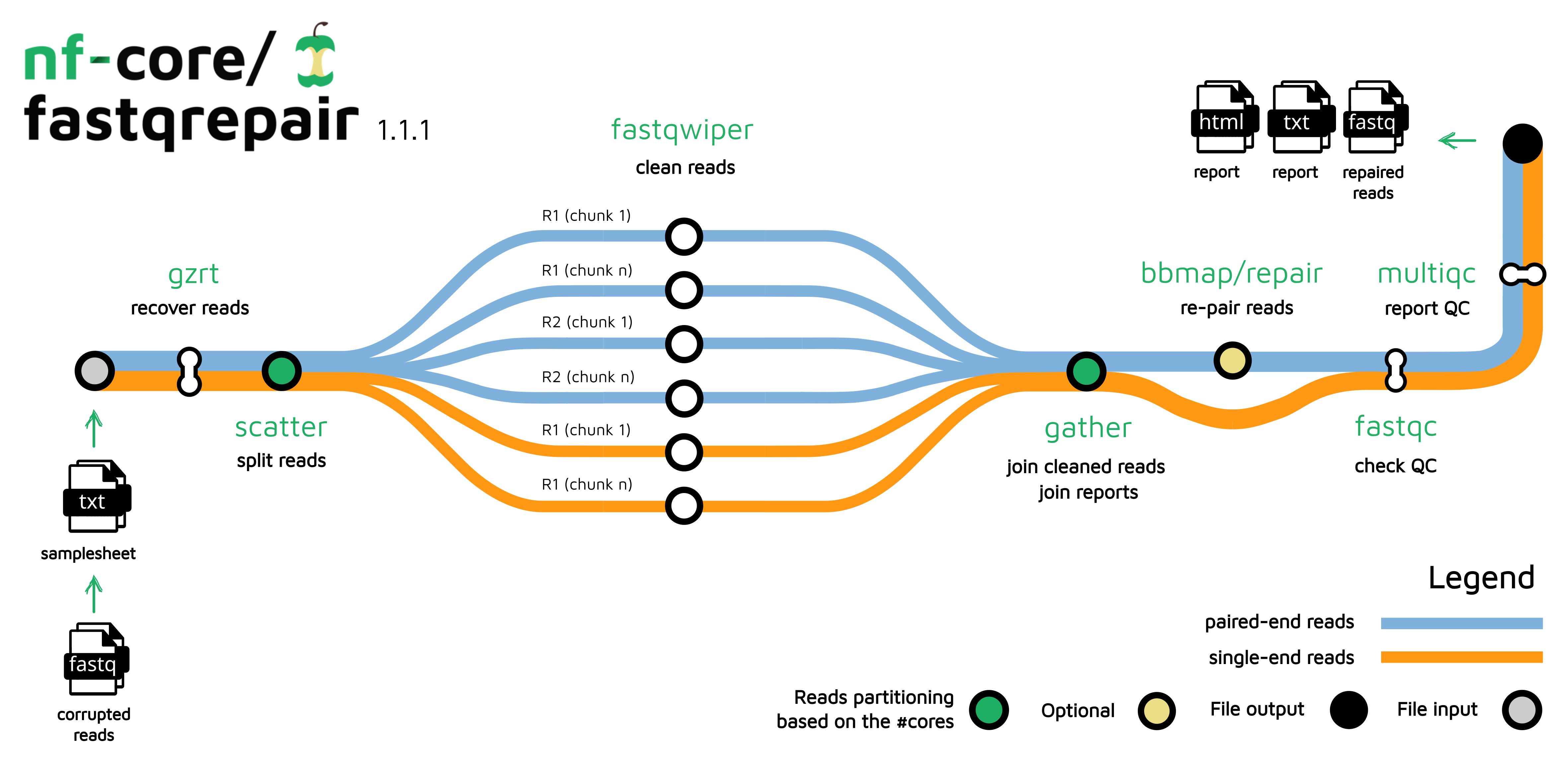
- Recover reads from corrupted fastq.gz file (
gzrt) - Make recovered reads well-formed (
wipertools) - Re-pair reads (
bbmap/repair.sh) - Check QC of recovered reads (
FastQC) - Aggregate and report QC (
MultiQC)
Usage
Note
If you are new to Nextflow and nf-core, please refer to this page on how to set-up Nextflow. Make sure to test your setup with -profile test before running the workflow on actual data.
First, prepare a samplesheet with your input data that looks as follows:
samplesheet.csv:
sample,fastq_1,fastq_2
mysampleA,sample_R1.fastq.gz,sample_R2.fastq.gz
mysampleB,sample_R3.fq,sample_R4.fq
mysampleC,sample_R5.fq.gz
Each row represents a FASTQ file (single-end) or a pair of FASTQ files (paired-end).
Warning
Rows with different file extensions (e.g., mysampleA,sample_R1.fastq.gz,sample_R2.fastq) are not allowed.
Now, you can run the pipeline using:
nextflow run nf-core/fastqrepair \
   -profile <test/docker/singularity/.../institute> \
   --input samplesheet.csv \
   --outdir <OUTDIR>
Warning
Please provide pipeline parameters via the CLI or Nextflow -params-file option. Custom config files including those provided by the -c Nextflow option can be used to provide any configuration except for parameters; see docs.
For more details and further functionality, please refer to the usage documentation and the parameter documentation.
Pipeline output
This pipeline produces clean and well-formed FASTQ files together with short textual reports of the cleaning actions.
To see the results of an example test run with a full size dataset refer to the results tab on the nf-core website pipeline page. For more details about the output files and reports, please refer to the output documentation.
Credits
nf-core/fastqrepair was designed and written by Tommaso Mazza.
Contributions and Support
If you would like to contribute to this pipeline, please see the contributing guidelines.
For further information or help, don't hesitate to get in touch on the Slack #fastqrepair channel (you can join with this invite).
Citations
If you use nf-core/fastqrepair for your analysis, please cite it using the following doi: 10.5281/zenodo.14796348
An extensive list of references for the tools used by the pipeline can be found in the CITATIONS.md file.
You can cite the nf-core publication as follows:
The nf-core framework for community-curated bioinformatics pipelines.
Philip Ewels, Alexander Peltzer, Sven Fillinger, Harshil Patel, Johannes Alneberg, Andreas Wilm, Maxime Ulysse Garcia, Paolo Di Tommaso & Sven Nahnsen.
Nat Biotechnol. 2020 Feb 13. doi: 10.1038/s41587-020-0439-x.
Generic options#
Less common options for the pipeline, typically set in a config file.
Display the help message.
Email address for completion summary.
More detail
Set this parameter to your e-mail address to get a summary e-mail with details of the run sent to you when the workflow exits. If set in your user config file (~/.nextflow/config) then you don't need to specify this on the command line for every run.
Display version and exit.
Display the full detailed help message.
Custom logo file to supply to MultiQC. File name must also be set in the MultiQC