nf-core/moleculardynamics

👩💻 I'm working on it, so please be patient.















Introduction
nf-core/moleculardynamics is a bioinformatics pipeline for running molecular dynamic simulations (MD) using GROMACS open-source software. This workflow enables researchers to perform standard protein simulations in a fully automated manner, with minimal configuration, on both local and high-performance computing (HPC) environments.
We are currently working on the following tasks:
- 🚀📆 Official release of the
nf-core/moleculardynamicspipeline. - 🛠👩💻 Expanding the pipeline’s capabilities to include more analysis modules (e.g., RMSF, distances), and integrating specialized tools for membrane proteins and protein-ligand complexes.
- 📚📝 Generating a comprehensive test dataset.
Pipeline
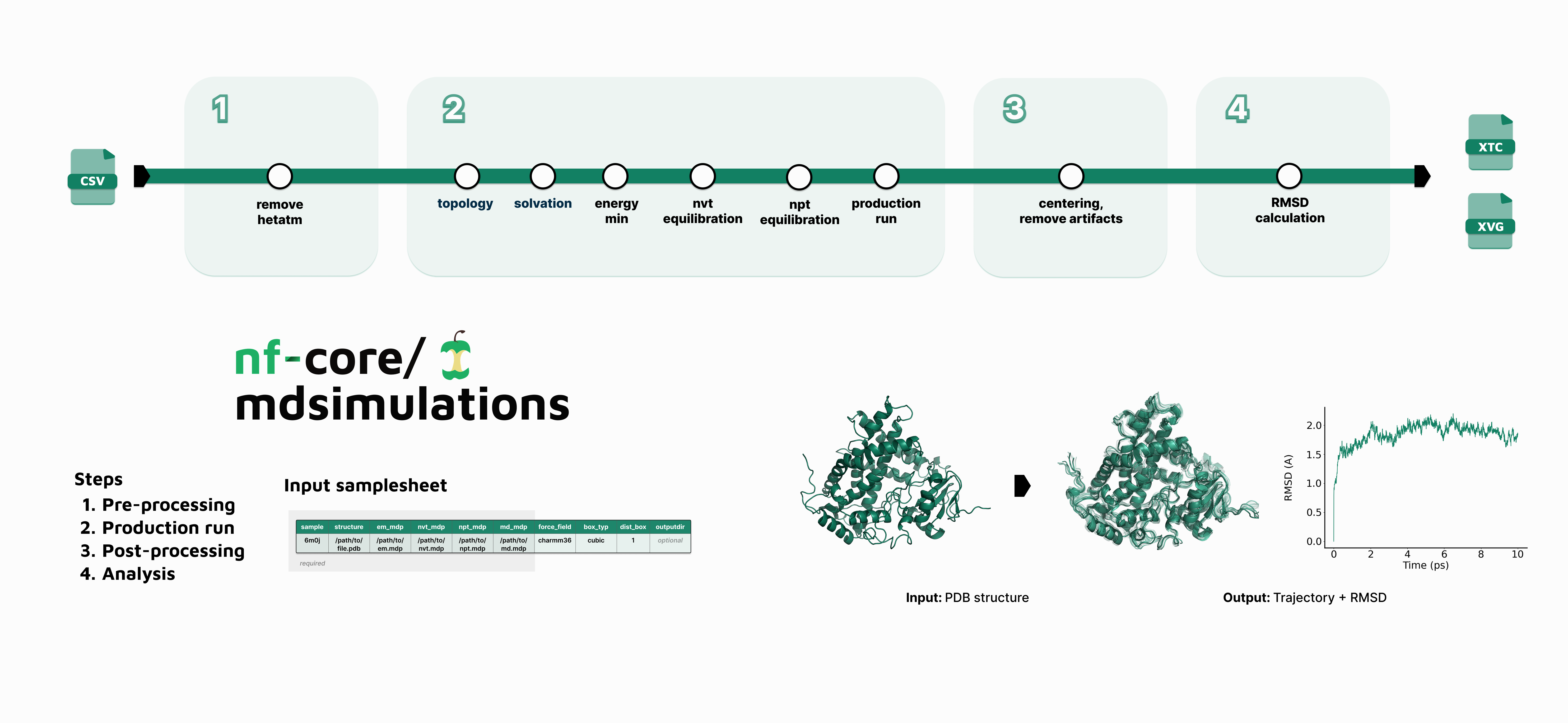
The nf-core/moleculardynamics pipeline automates a standard GROMACS MD simulation workflow. The major steps are:
- Input pre-processing: From the PDB structure, remove the missing atoms.
- Production run: Main subworkflow of the pipeline.
- Generation of molecular topology,
- System solvation, and ion addition to neutralize the system.
- Energy Minimization: Removal of steric clashes and relaxation of the initial structure.
- Equilibration: NVT (constant Number, Volume, Temperature) and NPT (constant Number, Pressure, Temperature) equilibration to bring the system to the desired temperature and density.
- Production MD: Execution of the main molecular dynamics simulation.
- Post-processing: Centering the protein and remove periodic boundary condition (PBC).
- Analysis: Preliminary analysis of the Root-Mean-Square Deviation (RMSD).
Usage
[👩💻 working on it]
Note
If you are new to Nextflow and nf-core, please refer to this page on how to set-up Nextflow. Make sure to test your setup with -profile test before running the workflow on actual data.
Warning
Please provide pipeline parameters via the CLI or Nextflow -params-file option. Custom config files including those provided by the -c Nextflow option can be used to provide any configuration except for parameters; see docs.
For more details and further functionality, please refer to the usage documentation and the parameter documentation.
Pipeline output
[👩💻 working on it]
To see the results of an example test run with a full size dataset refer to the results tab on the nf-core website pipeline page. For more details about the output files and reports, please refer to the output documentation.
Credits
nf-core/moleculardynamics has been developed by Sara Tolosa Alarcón (@sarata00) from the Computational Biology Group at the Barcelona Supercomputing Center under the deCYPher project and supervision of Miguel Romero-Durana (@migromero).
Contributions and Support
[👩💻 working on it]
If you would like to contribute to this pipeline, please see the contributing guidelines.
For further information or help, don't hesitate to get in touch on the Slack #moleculardynamics channel (you can join with this invite).
Citations
[👩💻 working on it]
An extensive list of references for the tools used by the pipeline can be found in the CITATIONS.md file.
You can cite the nf-core publication as follows:
The nf-core framework for community-curated bioinformatics pipelines.
Philip Ewels, Alexander Peltzer, Sven Fillinger, Harshil Patel, Johannes Alneberg, Andreas Wilm, Maxime Ulysse Garcia, Paolo Di Tommaso & Sven Nahnsen.
Nat Biotechnol. 2020 Feb 13. doi: 10.1038/s41587-020-0439-x.
Generic options#
Less common options for the pipeline, typically set in a config file.
Display version and exit.
Incoming hook URL for messaging service
More detail
Incoming hook URL for messaging service. Currently, MS Teams and Slack are supported.
Email address for completion summary, only when pipeline fails.
More detail
An email address to send a summary email to when the pipeline is completed - ONLY sent if the pipeline does not exit successfully.
Do not use coloured log outputs.
Send plain-text email instead of HTML.
Boolean whether to validate parameters against the schema at runtime
Method used to save pipeline results to output directory.
More detail
The Nextflow publishDir option specifies which intermediate files should be saved to the output directory. This option tells the pipeline what method should be used to move these files. See Nextflow docs for details.